
What Is HL7 FHIR for Global Health? Interoperability in Low-Resource Contexts
A research-based look at HL7 FHIR global health low resource interoperability, including DHIS2, OpenHIE, offline workflows, and national digital health systems.
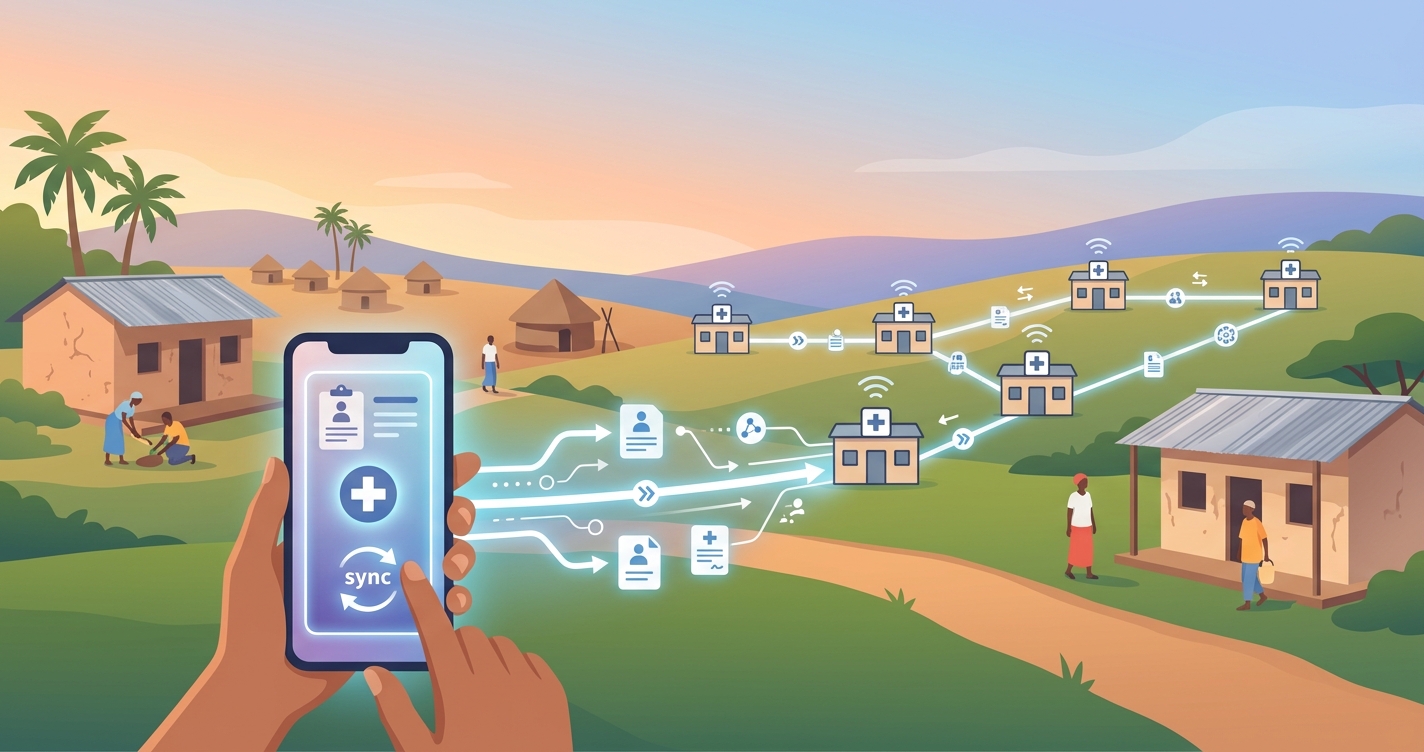
HL7 FHIR global health low resource interoperability has become a practical planning issue for ministries, implementing partners, and digital health teams. The basic question sounds technical, but the field consequence is simple: can data collected in a village, outreach site, or district clinic move into the systems national programs already trust? In low-resource contexts, that answer depends on whether exchange standards fit offline workflows, thin technical teams, and the very real fact that one program may be running across several partner platforms at once.
"DAKs are software-neutral mechanisms for translating narrative guidelines to support the design of digital systems." — Rosemary K. Muliokela, Kuwani Banda, Abdulaziz Mohammed Hussen, and colleagues, JMIR Medical Informatics (2025)
Why HL7 FHIR matters in global health interoperability
FHIR, short for Fast Healthcare Interoperability Resources, gives health systems a common way to structure and exchange data through web-friendly resources such as Patient, Observation, Encounter, and ServiceRequest. That sounds abstract until you map it to field work. A community health worker screens a pregnant patient on a phone. A referral goes to a district facility. Follow-up data lands in a national dashboard. FHIR is one of the standards trying to make that chain less brittle.
WHO has pushed the broader interoperability agenda for several years through its Global Strategy on Digital Health 2020-2025, and its collaboration with HL7 helped move FHIR further into public-sector digital health planning. The point is not that every ministry should rebuild its stack around one standard. The point is that countries need a shared format if they want screening, case management, reporting, and referral systems to stop acting like separate islands.
That is why FHIR tends to show up in conversations about:
- referral exchange between frontline apps and national platforms
- observation data from screening tools and facility systems
- patient matching across fragmented program databases
- API design for new digital public infrastructure projects
- data reuse across donor-funded tools that were never built together
What HL7 FHIR does well in low-resource settings
FHIR has a few traits that make it attractive in global health. It is modular, widely documented, and built around modern API patterns. Teams can start with narrow use cases instead of attempting whole-system standardization at once. That matters in low-resource settings, where implementation usually succeeds by reducing scope, not by expanding it.
A useful way to think about FHIR is that it solves the structure problem better than the ecosystem problem. It can define how a blood pressure observation or referral request should look. It does not decide who maintains the client registry, how offline sync works, or which ministry team owns the data governance model.
Comparison of interoperability approaches in low-resource contexts
| Approach | Main role | Strength in low-resource settings | Main limitation |
|---|---|---|---|
| HL7 FHIR | Standardized data model and API exchange | Good for structured data sharing across apps, registries, and reporting systems | Does not solve governance or architecture by itself |
| OpenHIE | Shared interoperability architecture | Helps define registries, exchange layers, and system boundaries | Requires national coordination and technical stewardship |
| DHIS2 native workflows | Program reporting and Tracker/event operations | Strong fit for national reporting and offline frontline workflows | Not a full substitute for cross-system exchange standards |
| WHO SMART Guidelines and DAKs | Policy-to-workflow standardization | Helps align digital workflows with national guidance | Needs implementation teams to translate logic into software |
Where FHIR fits alongside DHIS2 and OpenHIE
In practice, global health teams rarely deploy FHIR alone. They place it inside a larger architecture. DHIS2 may still hold reporting, Tracker workflows, and ministry dashboards. OpenHIE may define the shared services layer with client, facility, and health worker registries. FHIR then becomes the exchange language used at key handoff points.
That layered model is closer to how real programs operate. OpenHIE continues to frame interoperability as a modular, standards-based architecture for low-resource environments, not just a message format. Its community work in 2024 again emphasized country-driven information exchange, registry services, and shared infrastructure. Those pieces matter because ministries do not only need data to move. They need it to move into a governed environment where identifiers, facilities, and workers are defined consistently.
DHIS2 is relevant here for a different reason. Many ministries already use it as the backbone for aggregate reporting and, in some cases, person-level workflows. The harder question is not whether DHIS2 matters. It is how specialized screening tools, referral apps, and community workflows connect back into it. That is where FHIR-related tooling, adapters, and implementation guides become useful.
A workable stack in a low-resource setting often looks like this:
- a frontline mobile app captures screening or triage data offline
- sync happens when connectivity returns
- an interoperability layer maps records into shared profiles
- registry services help with patient, facility, and health worker identity
- DHIS2 or another national platform receives the data needed for reporting or follow-up
Current barriers to HL7 FHIR global health low resource interoperability
The literature is fairly consistent on this point: the standard itself is only part of the challenge. Muhammad Ayaz, Muhammad F. Pasha, Mohammed Y. Alzahrani, Rahmat Budiarto, and Deris Stiawan wrote in their systematic review of FHIR implementations that recurring barriers include legacy integration, privacy concerns, limited technical expertise, and data consistency. In low-resource settings, each of those problems gets sharper.
I think the most common failure is assuming that naming a standard is the same as implementing one. Teams say they are "using FHIR," but they have not agreed on profiles, identifiers, terminology bindings, or ownership. Once that happens, interoperability becomes a label rather than a capability.
Several barriers show up repeatedly:
- connectivity is unstable, so real-time exchange cannot be the default design assumption
- local technical teams may be small, making profile maintenance difficult
- partner-funded systems often map the same data differently
- national registries may be incomplete, which weakens record matching
- privacy rules and data-sharing permissions differ across programs and countries
These are not reasons to avoid FHIR. They are reasons to narrow the use case and govern it well.
Industry applications in global health programs
Community health worker workflows
FHIR can help when community screening data needs to move into referral and follow-up systems without forcing manual re-entry. That is especially useful in maternal health, hypertension screening, HIV programs, and district outreach where the first screen is only the beginning of the workflow.
Cross-program interoperability
Low-resource settings often have several donor-supported systems operating side by side. A TB workflow, an antenatal care tool, and a logistics platform may all touch the same patient journey. FHIR provides one way to normalize the handoff points even when the underlying software is different.
National digital public infrastructure
For countries building or refining digital public infrastructure, FHIR can act as a practical exchange layer rather than a total replacement for existing systems. That makes it easier to preserve established reporting tools while improving data movement between frontline applications and national systems.
Current Research and Evidence
The strongest recent evidence comes from the policy and implementation side, not from hype about universal standards.
WHO's digital health strategy made interoperability and open standards a formal priority for member states. That matters because ministries often need policy cover before they can push back on one-off, donor-specific integrations.
Rosemary K. Muliokela, Kuwani Banda, Abdulaziz Mohammed Hussen, and colleagues reported in JMIR Medical Informatics in February 2025 that WHO SMART Guidelines digital adaptation kits were implemented across five African pathfinder countries: Ethiopia, Ghana, Malawi, Zambia, and Zimbabwe. Their paper is useful because it shows how software-neutral implementation tools can standardize workflows while still allowing local adaptation.
The Ayaz, Pasha, Alzahrani, Budiarto, and Stiawan review remains relevant because it describes the same implementation pressures teams still face now: legacy systems, privacy, technical skill gaps, and consistency problems across deployments.
OpenHIE's 2024 community work also points in the same direction. The emphasis was on modular architecture, registry services, governance, and country-led exchange environments. That is a better reflection of field reality than the idea that a single API standard solves interoperability on its own.
What successful FHIR adoption usually has in common
- a narrowly defined use case, such as referrals or observations
- clear ownership for profiles, terminology, and governance
- offline-first workflow design at the field level
- reliable registry services or a realistic matching strategy
- implementation support after the pilot phase ends
The Future of HL7 FHIR for Global Health
The future of HL7 FHIR for global health probably looks less dramatic and more useful than many conference slides suggest. Adoption will likely expand through narrow, high-value workflows first: referrals, observations, patient summaries, and data exchange with national registries. That is slower than a platform reset, but it is how durable infrastructure usually gets built.
I also expect tighter links between FHIR, WHO SMART Guidelines, and country interoperability frameworks. If national teams can reuse policy logic, align it with implementation guides, and connect it to exchange standards already supported by local partners, the cost of interoperability falls in a meaningful way.
For low-resource settings, that is the real test. A standard is only valuable if it respects the operating conditions on the ground: intermittent internet, constrained staffing, long procurement cycles, and digital ecosystems assembled one program at a time. FHIR can help a lot in that environment. It just works best when it is treated as one layer in a broader architecture rather than the whole answer.
Frequently Asked Questions
What is HL7 FHIR in simple terms?
HL7 FHIR is a health data standard that defines how clinical and program information can be structured and exchanged through APIs and reusable resources such as Patient, Observation, and Encounter.
Why is FHIR relevant for global health programs?
It gives different systems a shared format for exchanging health data. That helps ministries, implementers, and software teams connect screening, referrals, follow-up, and reporting workflows without relying entirely on custom integrations.
Is FHIR enough by itself in low-resource contexts?
Usually not. Programs also need governance, registries, terminology management, offline workflows, and an architecture for how systems connect. That is why FHIR is often paired with OpenHIE, DHIS2, and WHO SMART Guidelines work.
How should ministries start with FHIR?
The most workable starting point is usually a narrow use case with clear ownership, such as referral exchange or observation sharing, rather than an attempt to redesign every national system at once.
Interoperability matters most when frontline data can move into systems that countries already rely on. For teams exploring how contactless and smartphone-based screening fit into that direction of travel, Circadify is building toward field-ready workflows. Explore our global health research hub, or continue with related reading on interoperability standards for global health platforms and how smartphone screening integrates with DHIS2.