Smartphone Diagnostics and Pandemic Preparedness: How They Connect
A research-based look at how smartphone diagnostics pandemic preparedness strategies connect across surveillance, field triage, and health system resilience.
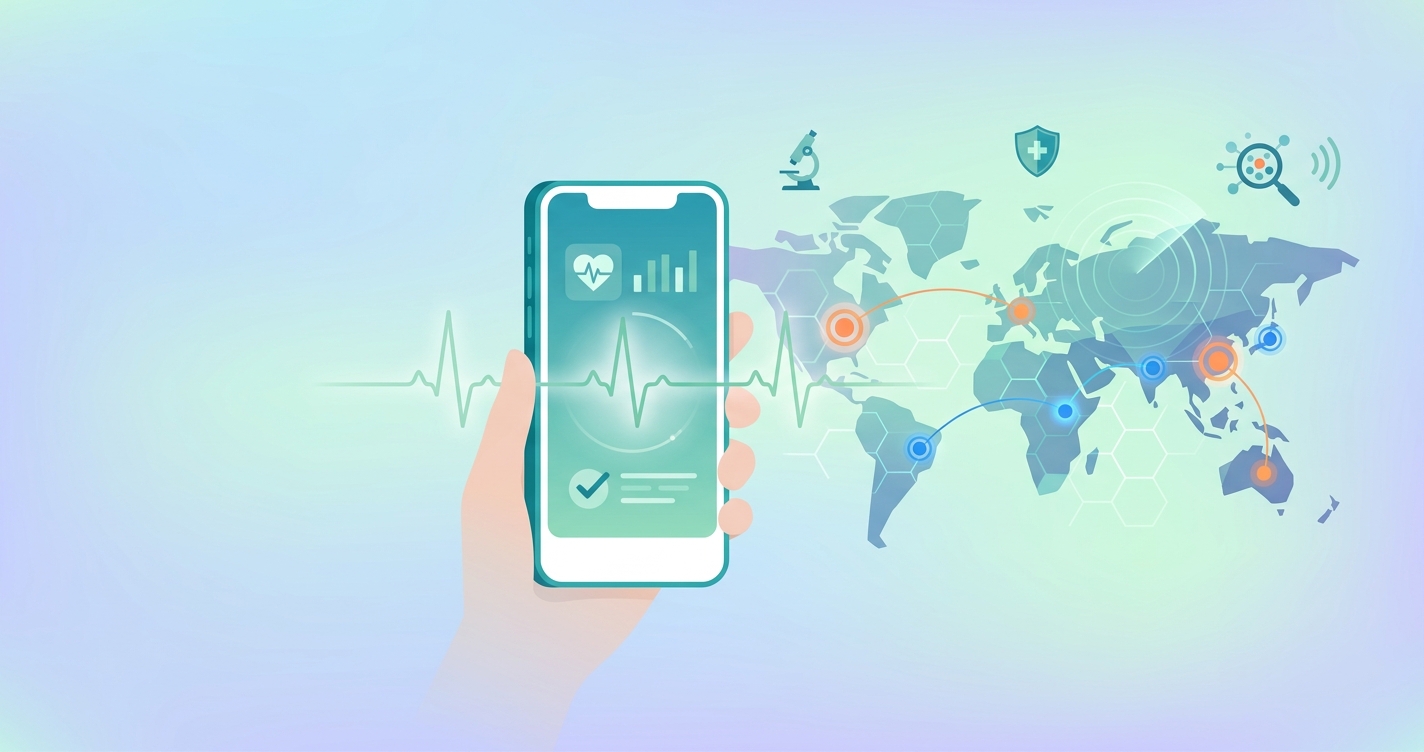
Smartphone diagnostics pandemic preparedness planning used to sound like a future-facing concept. After COVID-19, it feels much more immediate. Ministries of health, implementing partners, and outbreak teams now have a clearer sense of where health systems break under pressure: frontline triage slows down, reporting lags, equipment bottlenecks pile up, and the first usable signal often arrives too late. Smartphones do not solve those failures by themselves, but they sit unusually close to the point where preparedness either becomes real or falls apart.
"Approximately 47% of the global population has little to no access to diagnostics." — Lee Schroeder and colleagues, The Lancet Commission on diagnostics (2021)
Why smartphone diagnostics matter for pandemic preparedness
The connection starts with access. Schroeder and fellow commissioners argued in The Lancet in 2021 that nearly half the world still lacks adequate access to basic diagnostics for common conditions. In preparedness terms, that is not just a routine health-system weakness. It means an outbreak can spread through places where the first layer of testing, triage, or symptom escalation is thin to begin with.
Smartphones matter because they are already present where many other tools are not. A field worker may not have a laboratory analyzer, a connected monitor, or stable broadband. They often do have a phone. Berin Ozdalgic, Ali K. Yetisen, and Savas Tasoglu wrote in 2023 that smartphone and wearable diagnostics can reduce barriers in healthcare delivery, especially in resource-limited settings, because the phone can act as a data collection, processing, and communication device in one package.
That matters in preparedness for a simple reason: outbreak response depends on speed at the edge. If symptom capture, preliminary screening, referral documentation, and escalation all wait for a facility visit, the system reacts later. If some of that work begins at community level on a phone, health teams can at least shorten the distance between first concern and program visibility.
Comparison of preparedness models
| Model | Frontline diagnostic capacity | Reporting speed | Hardware burden | Preparedness strength |
|---|---|---|---|---|
| Paper-based surveillance | Low | Slow | Low | Weak early warning and hard follow-up |
| Facility-only diagnostics | Moderate to high inside clinics | Moderate | High at facilities | Stronger confirmation, limited community reach |
| Smartphone-led screening and triage | Moderate at community level | Fast when synced | Low to moderate | Better early detection and field visibility |
| Hybrid smartphone + facility workflow | High across referral chain | Fastest when integrated | Moderate | Best balance for preparedness and clinical rigor |
The hybrid model is the one I keep coming back to. Preparedness does not require pretending a smartphone is a lab. It requires using the phone to widen surveillance, tighten referrals, and make sure the limited confirmatory capacity goes to the right people faster.
A few patterns show up repeatedly in the literature:
- Preparedness improves when frontline workers can capture and transmit data early.
- Hardware-light workflows usually scale faster during emergencies.
- Community screening is more useful when it connects to referral and follow-up.
- Offline functionality matters in the exact places where outbreaks are hardest to see.
- Diagnostic access gaps make digital triage more valuable, not less.
Industry applications for smartphone diagnostics pandemic preparedness
Community surveillance and early warning
Preparedness lives or dies on whether unusual patterns are seen early. The 2024 review by Chisom Ogochukwu Ezenwaji, Esther Ugo Alum, and Okechukwu Paul-Chima Ugwu on digital health and pandemic response argues that mobile applications, wearable systems, electronic records, and related digital tools improve timely data collection, surveillance, and communication during outbreaks. That is the core public-health case for smartphone diagnostics. Even when the phone is not delivering a definitive diagnosis, it can move symptom clusters, risk flags, and preliminary measurements into a system that supervisors can act on.
In practical deployment terms, that can mean phone-based symptom intake for community health workers, smartphone imaging attachments, camera-led vital sign estimation, or simple digital workflows that log fever, respiratory symptoms, pulse, or household exposure. The point is not novelty. The point is getting more usable signals before a district team is already overwhelmed.
Field triage in low-resource settings
For medhealthscan.com's audience, low-resource deployment is where the connection becomes concrete. During a public-health emergency, outreach teams often have to screen large numbers of people with limited equipment, inconsistent electricity, and unreliable transport. A smartphone-based workflow can reduce the amount of extra gear a team has to carry while still standardizing intake and referral logic.
This is also where the 2023 review by Mansouri and Darvishpour is useful. Their scoping review of reviews on mobile health applications during COVID-19 found 22 review articles selected from a much larger evidence base, with recurring functions that included contact tracing, symptom monitoring, self-management, communication, and information delivery. In other words, mobile tools proved most useful when they handled workflow, not just one isolated measurement.
Public communication and behavior support
Preparedness is partly diagnostic, but it is also informational. WHO and the International Telecommunication Union launched Be He@lthy, Be Mobile in 2012 to help governments use mobile channels for population health communication and behavior support. The initiative began with noncommunicable diseases, but the broader lesson holds: once a mobile channel is trusted and operational, it can support risk communication, outreach, reminders, and continuity during crisis periods.
I think this gets overlooked. Preparedness is often discussed as if it begins in the lab and ends with stockpiles. In reality, a lot of it depends on whether people can be reached, triaged, and guided through the next step without adding friction.
Current research and evidence
The evidence base does not say smartphones replace standard diagnostics. It says they can strengthen the chain around diagnostics.
Schroeder and colleagues made the access problem plain in 2021: 47% of the global population has little to no access to diagnostics, and the gap is worst in primary care. That is a preparedness problem because primary care and community services are often where outbreaks first become visible.
Ozdalgic, Yetisen, and Tasoglu wrote in 2023 that smartphone and wearable diagnostics can support real-time data collection and secure transfer while extending diagnostic reach into settings with fewer resources. Their framing is especially relevant for global health teams because preparedness rarely fails from lack of high-end technology alone. It often fails because data from the edge never becomes operational soon enough.
Mansouri and Darvishpour's 2023 scoping review of COVID-19 mobile-health reviews found that the literature clustered around contact tracing, symptom checking, communication, telehealth support, and public information. That mix tells us something important. Mobile tools were most valuable when they helped systems coordinate people and information under pressure.
The 2024 review by Ezenwaji, Alum, and Ugwu reaches a similar conclusion from a broader pandemic-response angle. They argue that digital health tools improve surveillance, communication, and data management, but they also note the hard parts: governance, privacy, public trust, and the need to integrate digital tools into health systems instead of leaving them as disconnected pilots.
Those findings line up with what outbreak programs usually learn the hard way:
- A phone workflow is only as useful as the referral path behind it.
- Data that never reaches supervisors does not improve preparedness.
- Interoperability matters more during scale-up than during pilots.
- Training changes outcomes because frontline staff need to trust the workflow.
- Simpler tools often survive crisis conditions better than ambitious ones.
The future of smartphone diagnostics in preparedness
The next few years will probably bring less debate about whether smartphones belong in preparedness and more debate about how much of the workflow they should own.
One direction is sensor-light diagnostics. Camera-based measurement, portable attachments, and AI-assisted interpretation are all moving forward. Another is better integration with national digital platforms so field screening, community surveillance, and facility confirmation no longer sit in separate systems. That second part may matter more. A clever phone-based tool without integration is still just a pilot with nice screenshots.
I also suspect pandemic preparedness will become a stronger procurement argument for everyday digital health tools. Programs do not want technology that only works in peacetime. They want tools that can handle routine screening, then scale during outbreaks without changing the whole workflow. Smartphones fit that logic because they are already embedded in health programs, supervision systems, and communication channels.
For teams working in low-resource settings, the practical question is not whether a smartphone can do everything. It cannot. The better question is whether it can help a community worker capture risk earlier, route people faster, and feed outbreak intelligence into the systems that actually make decisions. In many settings, that answer is clearly yes.
Frequently Asked Questions
What does smartphone diagnostics mean in pandemic preparedness?
Usually it refers to using smartphones for screening, symptom intake, signal capture, decision support, data transmission, or accessory-based diagnostics that support outbreak surveillance and triage.
Can smartphone diagnostics replace laboratory confirmation during a pandemic?
No. In most preparedness models, smartphones strengthen the front end of detection and referral. Confirmatory testing still depends on the appropriate laboratory or clinical pathway.
Why are smartphones useful in low-resource outbreak settings?
Because phones are already widespread, relatively portable, and able to combine data capture, communication, and workflow support in one device. That lowers the equipment burden on frontline teams.
What is the biggest limitation of smartphone-based preparedness tools?
Usually it is not the phone itself. It is whether the workflow connects to referrals, supervision, and national data systems. A disconnected app can collect information without improving response.
For related reading, see our analysis of how smartphone screening integrates with DHIS2 and how to deploy health technology in conflict-affected areas. For broader global-health deployment research, solutions like Circadify are being developed for equipment-light screening and field workflows. Explore more at Circadify's global health research hub.