
How to Deploy Health Technology in Conflict-Affected Areas
A research-based analysis of how to deploy health technology in conflict-affected areas using offline workflows, ethical data practices, and resilient field operations.
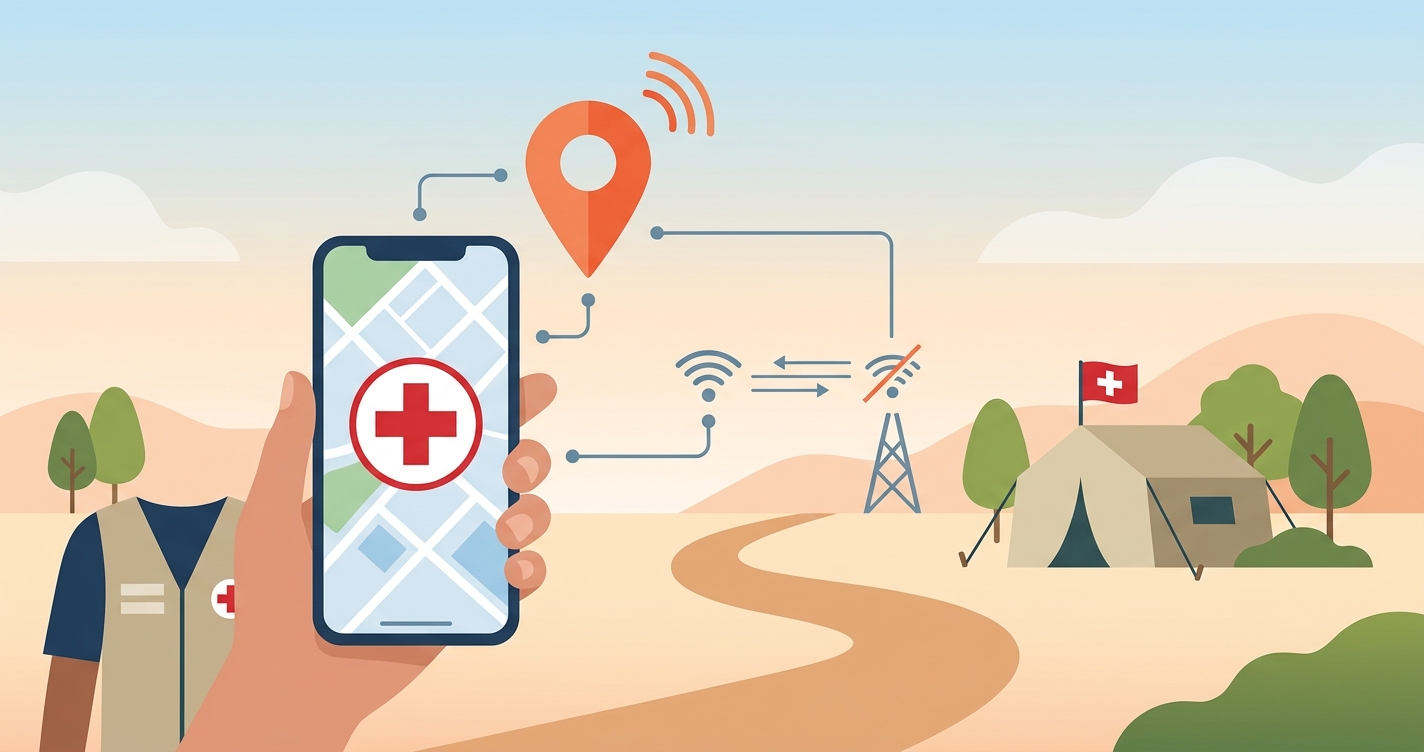
Deploy health technology in conflict-affected areas is a harder question than most product teams expect. The technical problem matters, but it is rarely the main one. In fragile settings, the real constraints are power, connectivity, staff turnover, security, patient movement, damaged referral networks, and the simple fact that a tool nobody trusts will not survive first contact with field reality. Good deployment planning starts there.
"Digital approaches can help, but only if privacy, consent, and security are built into the design from the beginning." — Eric D. Perakslis, Datavant, writing in Conflict and Health (2018)
Why deployment in conflict-affected areas looks different
A health app that works in an urban clinic can still fail in a conflict zone. Records may need to move between mobile teams, temporary clinics, partner NGOs, and national systems without stable internet. Devices may be shared. Patients may be displaced before follow-up. And a workflow that asks for too much data can create risk instead of reducing it.
That is why most successful deployments are deliberately boring in the best sense of the word. They keep the frontline workflow short. They work offline first. They minimize hardware dependencies. They make synchronization optional in the moment of care, not mandatory. I keep coming back to that point because too many deployment plans are still written as if connectivity were a constant.
Motti Haimi of The Max Stern Yezreel Valley College wrote in Frontiers in Medicine in 2024 that telemedicine in war zones is shaped by damaged infrastructure, cybersecurity concerns, workforce pressure, and barriers for special populations. That tracks with what humanitarian implementers already know: the tool is only one layer in a larger operating environment.
Comparison of common deployment models
| Deployment model | What it looks like in the field | Main advantage | Main risk |
|---|---|---|---|
| Paper-first backup with later digitization | Community workers document on paper, then upload later | Very resilient when devices fail | Slow reporting and high transcription loss |
| Offline-first mobile workflow | Data is captured on a phone and syncs when connectivity returns | Best fit for unstable connectivity | Requires disciplined device and identity management |
| Telemedicine hub-and-spoke | Frontline teams connect remote clinicians to patients or local staff | Expands specialist reach fast | Connectivity and scheduling can break the model |
| Device-heavy diagnostic deployment | Teams carry peripherals, chargers, and multiple accessories | Deeper measurement at point of care | Weight, maintenance, and replacement problems |
| Hybrid screening and referral model | Lightweight digital intake in the field plus confirmatory testing elsewhere | Strong balance of reach and rigor | Depends on referral pathways staying open |
A hybrid model tends to be the most realistic. Use the lightest possible frontline stack for screening, triage, and routing. Reserve the heavier diagnostic or specialist layer for facilities, referral hubs, or scheduled teleconsultation windows.
A few deployment rules show up again and again:
- Offline capture is a core requirement, not a premium feature.
- The first screen should take minutes, not half an hour.
- Staff need a safe fallback when devices fail or movement is interrupted.
- Data collection should be minimal and purpose-specific.
- Referral completion matters more than impressive dashboards.
Deploy health technology in conflict-affected areas: the operational core
The phrase deploy health technology in conflict-affected areas sounds broad, but in practice it comes down to a handful of decisions.
Start with continuity of care, not feature count
If the patient moves, can the case still move? That is the real question. A field workflow should preserve the minimum data needed for triage, referral, and follow-up without turning the phone into a portable medical record stuffed with sensitive details. Perakslis argued that digital health research in humanitarian settings has to be designed around consent, privacy, and the realities of vulnerability. That logic applies to implementation too. Teams should collect only what they can protect and use.
Design for intermittent infrastructure
Conflict settings often involve unreliable electricity, partial mobile coverage, blocked roads, and sudden service interruptions. A deployment that assumes daily cloud sync is fragile by definition. Offline-first capture, local encryption, deferred synchronization, and supervisor review queues are much more practical. This is one reason lightweight smartphone workflows keep gaining ground in global health deployments.
Match the tool to the worker
In many settings, the real user is not a hospital IT team. It is a community health worker, nurse, outreach volunteer, or mobile-clinic staff member working under time pressure. A 2024 BMC Public Health study led by Courtney T. Blondino surveyed 1,141 community health workers across 28 countries and found that digital-tool training was associated with higher use and stronger belief that the tools improved their impact. The point is simple: training changes adoption more than interface polish alone.
Build for handoffs, because handoffs are where programs break
Conflict-area care delivery is full of handoffs: one NGO to another, community worker to facility, temporary camp to district system, telehealth consult to local follow-up team. If patient identifiers, referral logic, and status updates are inconsistent, the technology becomes another layer of fragmentation. That is why interoperability and simple status states matter so much.
Industry applications in humanitarian and fragile settings
Community health worker programs
For community health worker teams, the winning setup is usually the one that reduces kit burden. A phone-based workflow can guide symptom intake, simple screening, risk flags, and referral status without requiring a bag full of accessories. In low-resource environments, zero-equipment or low-equipment workflows are not just cheaper. They are easier to sustain when supply lines are uneven.
Outbreak and infectious disease response
A 2024 Medicine paper by Okechukwu Paul-Chima Ugwu of Kampala International University and co-authors reviewed how technology supports infectious disease response in conflict zones. Their analysis focused on surveillance, telemedicine, mobile reporting, and AI-supported tools, but it also made the usual weakness plain: none of this works well if governance, trust, and operational capacity are missing. Technology can speed response. It cannot substitute for delivery networks.
Telemedicine and specialist access
Remote care can be valuable when specialists cannot travel safely or when local facilities have lost staff. Haimi's 2024 review argues that telemedicine can extend care in war zones, but bandwidth limits, patient privacy, legal ambiguity, and unequal access remain real barriers. In other words, telemedicine is often useful, but it should be treated as part of a broader service model rather than a standalone answer.
Research and humanitarian program management
Conflict settings are also research settings, though that raises hard ethical questions. Perakslis wrote that digital tools can improve monitoring, consent workflows, and data quality, but only if teams treat ethics as operational design rather than paperwork. I think that framing is right. In fragile environments, bad data practice is not a compliance issue first. It is a patient-safety issue.
Current research and evidence
The evidence base around digital health in conflict-affected areas is still uneven, but a few themes are consistent.
First, ethics and security are inseparable from deployment. Perakslis's 2018 paper in Conflict and Health argued that digital systems in humanitarian settings need stronger protections around privacy, consent, and governance because the consequences of exposure are much higher than in routine care environments.
Second, telemedicine is promising but constrained. Haimi's 2024 Frontiers in Medicine review found that war-zone telemedicine can improve access for isolated populations and specialist-poor settings, yet it remains limited by connectivity, damaged infrastructure, language barriers, and the needs of children, older adults, and displaced populations.
Third, conflict-response technology works best when it supports a workflow that already exists. Ugwu and colleagues wrote in 2024 that tools for surveillance, communication, and infectious disease response can help in conflict zones, but they still depend on coordination, local capacity, and policy support.
Fourth, field adoption depends heavily on workforce enablement. Blondino's 2024 multi-country CHW survey did not focus only on conflict zones, but its findings are still relevant here. When workers are trained and see practical value, digital tool use rises. That sounds obvious, but it is one of the clearest lessons in this space.
A practical reading of the literature leads to a short list of evidence-backed priorities:
- Keep data collection narrow and tied to real decisions.
- Use offline-first architecture whenever service interruptions are likely.
- Plan for shared devices, lost devices, and rapid staff turnover.
- Treat referral tracking as a core workflow, not an afterthought.
- Train supervisors and field staff together so escalation paths are clear.
The future of health technology in conflict-affected areas
The future probably belongs to smaller stacks, not bigger ones. That means more software that can run on standard smartphones, more modular interoperability with national platforms, and more screening or triage models that do not require extra hardware in the field.
I also expect deployment standards to get stricter. Humanitarian buyers increasingly want to know how tools behave offline, what happens when a device disappears, how quickly a new worker can be trained, and whether records can move into broader health information systems later. Those are healthy questions. They force vendors and implementers to think like operators instead of demo teams.
For medhealthscan.com's audience, that is the real takeaway. The best conflict-area deployment is usually not the most advanced technical concept. It is the one that survives unstable power, weak connectivity, fragmented referral networks, and a workforce that cannot spend all day babysitting software.
Frequently Asked Questions
What is the first priority when deploying health technology in conflict-affected areas?
Usually it is workflow resilience. If the tool cannot work with unstable connectivity, power interruptions, staff turnover, and patient movement, the rest of the design barely matters.
Should health programs deploy device-heavy diagnostic tools in conflict settings?
Sometimes, but only when the logistics support them. Many programs get better results from a lighter screening layer in the field and a separate confirmatory or specialist layer elsewhere.
Why is offline-first design so important in humanitarian health technology?
Because connectivity is often intermittent or absent at the moment of care. Offline-first systems let teams capture, review, and later synchronize information without stopping care delivery.
How much patient data should frontline teams collect?
Only what they need for the immediate decision, referral, and follow-up. In conflict settings, extra sensitive data can create unnecessary risk if devices are shared, lost, or seized.
For related reading, see our analysis of how smartphone screening integrates with DHIS2, interoperability standards for global health platforms, and telehealth and rPPG: bridging the gap in virtual visits. For broader deployment thinking, solutions like Circadify are being built for low-equipment health workflows in the field. Explore more at Circadify's global health research hub.