
Scaling From Pilot to National Program: Health Tech Lessons
What it takes to scale a health tech pilot into a national program, from governance and financing to interoperability, field workflows, and ministry ownership.
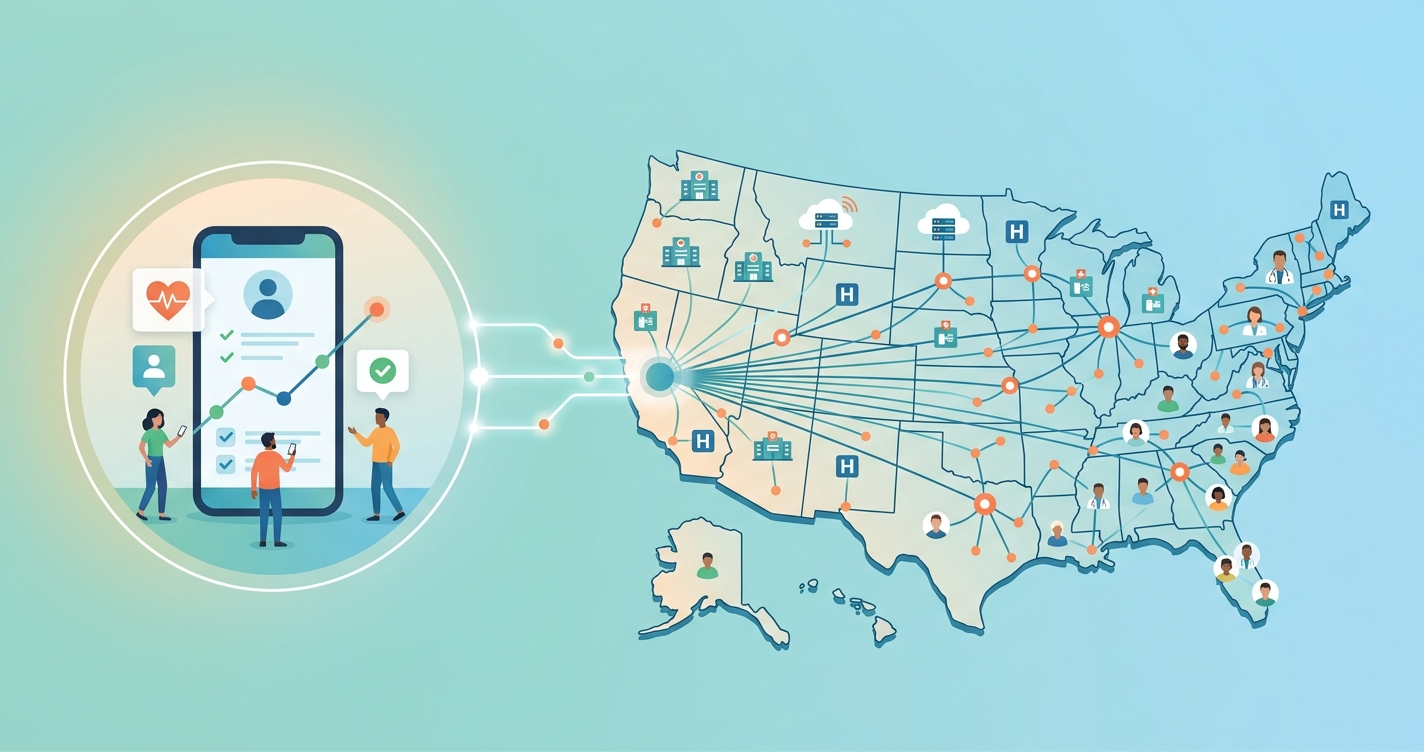
Scaling pilot national program health tech work usually looks easier on a conference stage than it does in a ministry budget meeting. A pilot can show promise with donor support, a focused geography, and a small group of highly engaged implementers. National scale is different. It forces every weak assumption into the open: procurement, connectivity, training, data governance, supervision, uptime, political ownership, and the simple question of who pays when the grant ends.
"Historically, fewer than 1% of digital health pilots have achieved institutionalization." — PATH, The Journey to Scale: Moving Together Past Digital Health Pilots
Scaling pilot national program health tech: what actually changes
The jump from pilot to national program is not just a bigger version of the same project. It is a different operating model.
Christina Wadhwani, Koku Awoonor-Williams, Peter Lamptey, Cees Hesp, Rowena Luk, and Ann Aerts argued in their review of digital health scale-up in low- and middle-income countries that programs usually succeed when five conditions line up: a real user need, engaged stakeholders, simple and adaptable technology, a supportive policy environment, and enough infrastructure to keep the system running. That sounds obvious, but it is where many pilots break down. They prove desirability in one district without proving repeatability across fifty.
Dr. Alain Labrique at the World Health Organization has made a similar point in discussions around national digital health strategy: countries need a clear architecture, not a collection of disconnected tools. A pilot can survive on goodwill and improvisation. A national program cannot. It needs governance, standards, and a plan that still works when the original champions move on.
A useful way to frame the problem is to separate pilot success from system success.
| Question | Pilot mindset | National program mindset |
|---|---|---|
| Primary goal | Show promise quickly | Deliver routine service reliably |
| Geography | Limited districts or facilities | Multi-region or nationwide coverage |
| Funding | Grant-backed or innovation budget | Budgeted operating model with long-term ownership |
| Workflow design | High-touch support acceptable | Must work with ordinary staffing levels |
| Technology | Can tolerate workarounds | Needs interoperability, maintenance, and support |
| Governance | Often led by project team | Must be ministry-led and contractually clear |
| Evidence bar | Early outcome signals | Operational, financial, and policy viability |
That table may be the central lesson. National programs are judged less on novelty than on whether they keep functioning under normal conditions.
- Scale exposes workflow friction that pilots can hide.
- National programs require ministry ownership, not just partner enthusiasm.
- Interoperability matters more at scale than feature depth.
- Training models must survive staff turnover.
- Financing has to move from special funding to recurring budget logic.
Where promising health tech pilots usually stall
Some pilots fail because the technology is weak. More often, they stall because the surrounding system was never designed for expansion.
PATH's work on digital health "pilotitis" has been blunt about this for years. The organization argued that scale should mean institutionalization, not just moving beyond a pilot phase. In other words, the solution has to become part of routine service delivery. That is a much higher bar than publishing encouraging pilot data.
Sara Chamberlain, Priyanka Dutt, Anna Godfrey, and Radharani Mitra made this concrete in their 2021 BMJ Global Health paper on transitioning Kilkari and Mobile Academy to the Government of India. Their case study is valuable because it does not romanticize scale. It describes trade-offs, the difficulty of private-sector business models in low-resource settings, the need to reassess program components before expansion, and the importance of defining governance structures early. By the time the program transitioned in 2019, Mobile Academy had graduated about 206,000 frontline health workers and Kilkari had reached roughly 10 million subscribers. That is real scale, and it came with redesign, negotiation, and operational compromise.
The uncomfortable truth is that a pilot often tests whether a tool can work. National rollout tests whether a health system can carry it.
Industry applications
Community health worker programs
For community health worker deployments, the first scaling problem is usually not the app. It is supervision. A pilot might rely on a small number of motivated trainers and daily troubleshooting. National programs need simpler training loops, offline resilience, and reporting structures that district managers can actually use. If field teams need constant outside intervention, the model is not ready.
Screening and triage workflows
Programs built around smartphone-based screening or triage need especially careful workflow design at scale. A district pilot can tolerate ad hoc referral pathways. A national program cannot. The referral logic, escalation pathways, and data handoff to national systems have to be explicit. This is where interoperability with platforms such as DHIS2 or other national reporting systems stops being a nice feature and becomes basic infrastructure.
Donor-funded innovation programs
Donor-backed pilots often move fast because procurement is flexible and support is concentrated. At national level, those advantages fade. Procurement cycles lengthen. Vendor management becomes formal. Data hosting questions become political. Ministries want visibility into contracts, access controls, and long-term maintenance. That is not bureaucracy for its own sake. It is what sustainability looks like.
Current research and evidence
Several sources keep pointing to the same pattern.
In The Journey to Scale, PATH argued that digital health only creates meaningful impact when it becomes routine and institutionalized. The paper's estimate that fewer than 1% of pilots reach that point is striking partly because it feels familiar to anyone who has watched promising projects disappear after donor funding ends.
The Wadhwani-Awoonor-Williams-Lamptey-Hesp-Luk-Aerts review pulled lessons from real implementation experience and identified five recurring requirements for scale: tangible benefit, stakeholder engagement, usable technical design, policy alignment, and an enabling ecosystem. Ann Aerts brought a foundation perspective to that work, while Koku Awoonor-Williams contributed the view of a public health leader working close to service delivery in Ghana. That combination matters. Scaling is rarely blocked by one issue alone.
The India case study from Chamberlain, Dutt, Godfrey, and Mitra adds another layer. Their main contribution is practical honesty. They show that scaling may require changing the business model, simplifying parts of the service, and accepting that what expands nationally may not look identical to what was piloted locally. Piloting apples and scaling oranges, as they put it, is not necessarily failure. Sometimes it is adaptation.
WHO's digital health strategy work reinforces the governance side of the story. Alain Labrique has repeatedly argued that countries need an overall architecture for digital transformation rather than fragmented tools purchased one by one. That is especially relevant in low-resource settings, where ministries cannot afford overlapping systems with separate training, separate support contracts, and separate data silos.
A few evidence-backed lessons stand out.
- Programs scale more smoothly when they solve a workflow problem frontline teams already feel.
- National ownership should be designed in from the beginning, not bolted on at transition.
- Simplicity beats feature richness when support capacity is thin.
- Clear governance and financing decisions matter as much as technical performance.
- Adaptation during scale-up is normal and often necessary.
The future of scaling health tech beyond the pilot phase
I think the next generation of successful national programs will look less like isolated apps and more like service layers that fit inside existing public-health systems. Ministries are becoming harder to impress with standalone innovation claims, and that is probably healthy. They want evidence, yes, but they also want interoperability, local control, training models that survive turnover, and operating costs they can explain.
For global health teams working in low-resource settings, that means the best scale-up plans will start earlier. They will ask uncomfortable questions in the pilot phase: who owns procurement, where does the data live, how does supervision work, what happens when connectivity fails, and which parts of the workflow are still too fragile? Those questions can slow a pilot. They also make national expansion more believable.
Solutions in this space, including the kind of smartphone-based screening infrastructure Circadify is building toward, will be judged on whether they can fit into real public-health operations. Not just whether they demo well.
Frequently Asked Questions
Why do so many health tech pilots fail to become national programs?
Because pilot success usually measures short-term feasibility, while national programs require long-term financing, governance, procurement, training, interoperability, and ministry ownership.
What is the biggest difference between a pilot and a national rollout?
A pilot can rely on exceptional support and temporary funding. A national rollout has to work under routine conditions across many regions with ordinary staffing and formal accountability.
Does scaling always mean using the exact same model that worked in the pilot?
No. Research on large programs in India suggests scale-up often requires redesign, simpler workflows, and new governance arrangements. Adaptation is part of the process.
What should ministries ask before approving a national digital health rollout?
They should ask who owns the system, how it will be financed, how it integrates with existing reporting platforms, what support model exists for the field, and whether the workflow still works outside high-touch pilot conditions.
For related reading, see our analysis of how smartphone screening integrates with DHIS2 and how contactless screening supports TB and HIV programs. For broader context on field-ready digital health systems, visit circadify.com/blog.