How Contactless Screening Supports TB and HIV Programs
A research-based look at how contactless screening supports TB and HIV programs through community triage, digital workflows, and lower-friction field operations.
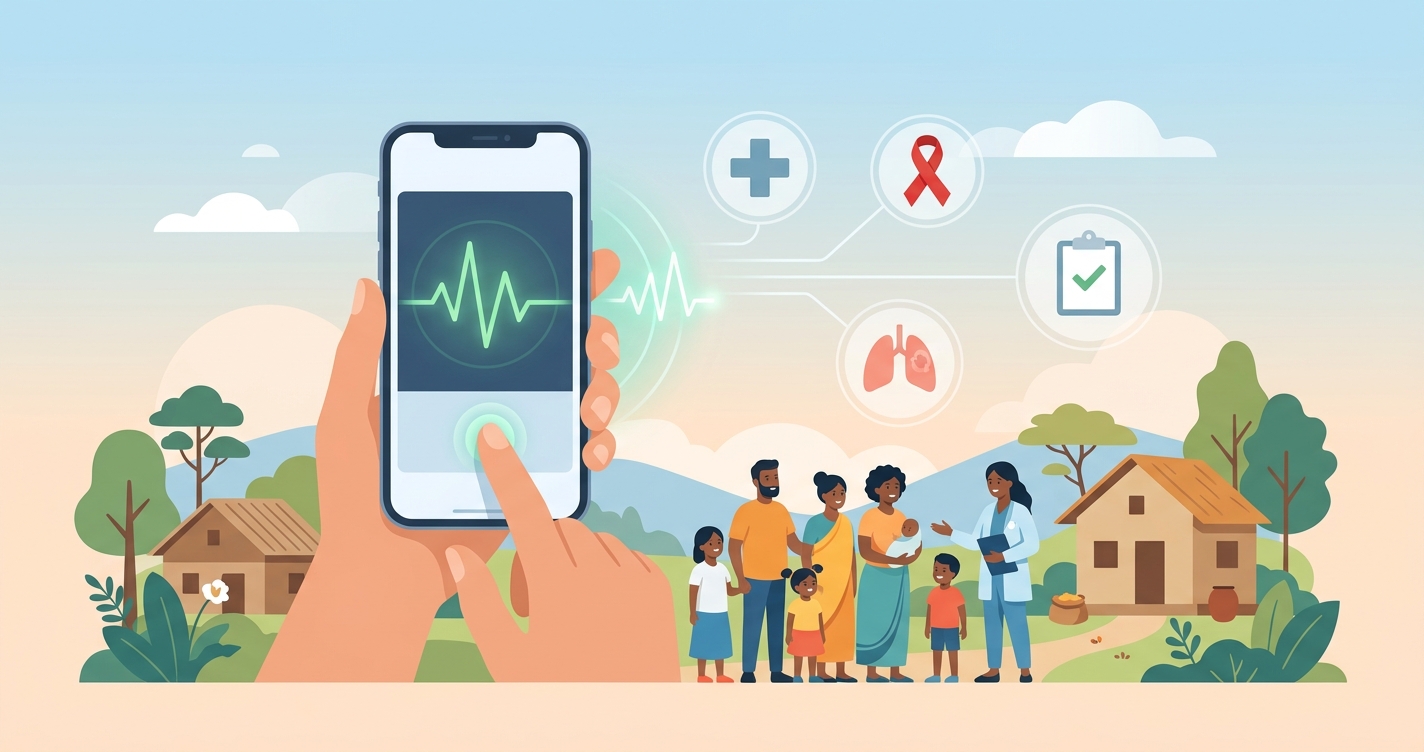
Contactless screening TB HIV programs are getting more attention for a simple reason: the biggest bottleneck in many field programs is not treatment science, but the first mile of identification, triage, and follow-up. When outreach teams are working across rural districts, informal settlements, border zones, or mobile clinics, every extra device, every paper register, and every repeated touchpoint slows the program down. Contactless or low-contact digital screening does not replace confirmatory diagnostics, but it can make front-end screening easier to scale.
"TB remains the leading cause of death among people living with HIV worldwide." — World Health Organization, tuberculosis and HIV guidance cited in 2025 updates to systematic screening recommendations
Why contactless screening TB HIV programs fit field realities
In practice, contactless screening in TB and HIV programs usually means smartphone-led or camera-enabled triage, digital symptom capture, rapid risk flagging, and a workflow that moves people toward confirmatory testing without building a heavy equipment stack at the community level. I think that distinction matters. The value is not that a phone somehow replaces sputum testing, chest radiography, or HIV confirmatory algorithms. The value is that it helps programs decide who needs the next step, document that decision fast, and reduce friction for workers who are already carrying too much.
WHO's 2021 consolidated tuberculosis screening guidance pushed systematic screening toward clearly defined risk groups, including household contacts of people with TB and people living with HIV. The same WHO guidance says screening should happen regularly in HIV care encounters because people living with HIV face a far higher risk of active TB. A field program does not need more proof that early triage matters. It needs a way to do that triage consistently in difficult operating conditions.
The HIV side has moved in a similar direction. WHO's 2024 differentiated HIV testing services guidance puts more weight on community-based, network-based, and self-testing pathways, with stronger integration into prevention and treatment workflows. That does not automatically mean camera-based screening, but it does support the broader logic of lower-friction, decentralized, digitally managed entry points.
Comparison of screening models in TB and HIV programs
| Model | What happens at community level | Operational upside | Main constraint |
|---|---|---|---|
| Paper-first outreach | Symptoms, referrals, and follow-up are recorded manually | Low technical barrier at launch | Slow reporting and weak follow-up visibility |
| Device-heavy screening | CHWs carry multiple peripherals or diagnostic accessories | Better measurement depth in some use cases | Higher cost, charging burden, and replacement risk |
| Contactless or low-contact digital screening | Phone-led triage, symptom capture, workflow prompts, and digital referral support | Faster scale-up and less hardware burden | Still depends on referral pathways and confirmatory testing |
| Hybrid workflow | Contactless triage at community level plus facility-based confirmatory tools | Good balance between reach and clinical rigor | Requires strong data handoff between field and facility |
That hybrid model is where many TB and HIV programs seem to be heading. Use the lightest possible frontline workflow to widen the top of the funnel, then reserve the more expensive or specialized diagnostic steps for facility or campaign settings.
A few patterns keep showing up in successful programs:
- The best frontline workflow is the one a CHW can finish quickly in the field.
- Digital triage matters most when referral completion is also tracked.
- Hardware-light models usually scale faster across districts.
- Offline sync is not a luxury feature in community TB and HIV work.
- Program managers care less about novelty than about how many missed cases they can reduce.
Industry applications for TB and HIV programs
Community TB case finding
TB outreach campaigns often begin with symptom screening, risk profiling, household contact tracing, or community mobilization before any confirmatory test is performed. That makes TB a strong fit for contactless or low-contact digital screening. WHO's systematic screening recommendations are clear that household contacts and people living with HIV are priority populations. A digital workflow can help field teams standardize those questions, assign risk flags, and create cleaner referrals to chest X-ray, molecular testing, or facility review.
Recent outreach programs using AI-assisted chest X-ray infrastructure show what happens when the community step gets more efficient. Agent-search results pointed to 2024 and 2025 reporting around CAD-supported community TB screening in Africa, including Kenyan and Nigerian programs that screened large populations with portable digital X-ray and automated interpretation support. Those programs still rely on imaging and diagnostic confirmation, of course, but their logic is the same one driving contactless screening: bring the first screen closer to the patient and reduce dependence on scarce specialized staff.
HIV testing and differentiated service delivery
HIV programs have a different care pathway, but a similar operational challenge. The first interaction might happen through outreach, partner notification, community-led testing, or self-testing support rather than inside a facility. WHO's 2024 differentiated HIV testing services guidance expands that decentralized model further, especially through self-testing and network-based approaches. Digital screening tools fit naturally here because they can guide eligibility checks, symptom prompts, linkage workflows, and follow-up reminders without demanding much from the worker beyond a phone.
That matters most in differentiated service delivery models. If the goal is to meet people where they are, the workflow cannot assume a long in-clinic assessment. It has to be short, portable, and easy to document.
Integrated TB-HIV programs
TB-HIV integration is where contactless screening may have the clearest operational case. TB remains a major cause of mortality among people living with HIV, and WHO says people living with HIV should be screened regularly for TB. When programs run separate workflows for HIV outreach, TB symptom review, referral, and follow-up, they create extra loss points. A single phone-based intake can combine symptom prompts, risk classification, referral tracking, and supervisor visibility across both programs.
I keep coming back to a boring but important point: integrated workflows are usually more valuable than sophisticated features. A simple digital triage layer that flags cough, fever, weight loss, night sweats, HIV risk, prior exposure, or treatment interruption may not look impressive in a procurement deck, but it can reduce the number of people who disappear between outreach and diagnosis.
Current research and evidence
The evidence base around digital community workflows is stronger than it was even a few years ago. A 2024 paper on the use and potential impact of digital health tools at the community level, surfaced through agent-search, described findings from 1,141 community health workers across 28 countries. The study linked digital-tool training with higher use of digital devices and stronger belief that those tools improved impact. That sounds obvious, but it is not trivial. It suggests that adoption problems are often program-design problems, not just technology problems.
UNICEF's Rwanda cEMR work offers another useful field signal. In 2024 reporting, UNICEF said the country was scaling community electronic medical records across all 30 districts, with a target of 58,567 CHWs by the end of 2026. The shift away from paper registers was not framed as a gadget story. It was framed as a continuity-of-care and data-use story. That is exactly how contactless screening should be understood in TB and HIV programs too.
WHO's TB guidance adds the epidemiologic urgency. Agent-search returned WHO's summary that people living with HIV are about 14 times more likely to develop TB disease than people without HIV, and that systematic TB screening should occur at every health-worker encounter for this group. When risk is that concentrated, even modest improvements in screening consistency can matter.
On the HIV side, WHO's 2024 testing guidance supports a strategic mix of facility, community, network-based, and self-testing approaches. The implication for digital teams is straightforward: the entry point is now distributed. Programs need software and workflows that can support distributed screening and still preserve linkage to care.
The literature and implementation guidance point to the same operational conclusions:
- Contactless screening works best as a triage and workflow tool, not as a standalone diagnostic answer.
- TB and HIV programs benefit when outreach data is visible quickly to supervisors and referral teams.
- Training still changes utilization more than interface design alone.
- Hardware-light models tend to be easier to sustain across districts.
- Integrated TB-HIV workflows can reduce handoff failures between programs.
The future of contactless screening in TB and HIV programs
The next phase will probably be less about whether digital community screening is possible and more about how tightly it connects to national systems. Rwanda's cEMR push is one sign of that. WHO's HIV digital adaptation work is another. Countries do not want disconnected pilot apps anymore. They want workflows that can support community screening, facility referral, and program reporting in the same chain.
I also expect the definition of contactless screening to broaden. For some programs it will mean phone-led symptom triage and digital referral. For others it may include camera-based vital-sign estimation, automated risk stratification, or better supervision dashboards. The best version is not the flashiest one. It is the version that keeps the frontline stack light and makes case finding less fragile.
That is especially relevant for medhealthscan.com's audience: implementers, digital health researchers, and field platform teams working in low-resource settings. They are usually not asking for magic diagnostics. They are asking whether a worker in the field can identify risk faster, record it once, sync later, and keep the case moving.
Frequently Asked Questions
What does contactless screening mean in TB and HIV programs?
Usually it means a hardware-light digital workflow for triage, symptom capture, referral support, or preliminary screening that reduces physical contact and administrative burden at the community level. It does not replace confirmatory TB or HIV diagnostics.
Can contactless screening diagnose TB or HIV on its own?
No. In program terms, it is best understood as a front-end screening and workflow layer. Confirmatory testing still requires the appropriate diagnostic pathway.
Why is contactless screening useful for community health workers?
Because CHWs often work with limited time, power, connectivity, and transport. Phone-led screening and referral workflows can reduce paperwork, simplify follow-up, and make supervision easier.
Why are TB-HIV programs a strong fit for digital screening workflows?
Because both programs depend on early identification, repeat follow-up, and reliable linkage to care. Integrated digital workflows can reduce the number of people lost between outreach, screening, referral, and treatment initiation.
For related reading, see our analysis of mobile health in low-resource settings, how community health workers collect vital signs in the field, and how smartphone screening integrates with DHIS2. For broader deployment thinking, solutions like Circadify are being built for this direction of travel in global health. Explore more at Circadify's global health research hub.