Can a smartphone really replace a portable clinic in rural areas?
Can a smartphone replace a portable clinic in rural areas? A research-based look at where smartphone screening helps, and where clinics still matter.
Can a smartphone really replace a portable clinic in rural areas?
Smartphone replace portable clinic is the kind of question people ask when rural health systems are under real pressure. A portable clinic sounds concrete: staff, equipment, shelves, diagnostics, a place to stand. A smartphone sounds almost too small for the job. But in low-resource settings, the better question is not whether a phone can replace an entire clinic. It is whether a phone can take over enough of the first-contact workflow—screening, triage, follow-up, referral, and data capture—to reduce how often a portable clinic has to do everything itself.
“Digital health interventions are not sufficient on their own,” the World Health Organization wrote when it released its first guideline on digital health interventions in 2019. WHO leaders including Dr. Tedros Adhanom Ghebreyesus and scientist Dr. Garrett Mehl framed digital tools as useful only when they fit the surrounding health system.
Smartphone replace portable clinic is mostly a triage question, not a full replacement question
I keep coming back to one basic distinction. Portable clinics deliver care. Smartphones usually organize care.
That difference matters because many rural bottlenecks happen before treatment starts. A frontline worker may need to register a patient, capture symptoms, decide whether the case looks urgent, record household history, trigger a referral, and report the encounter upstream. None of that requires a tent, exam table, or van every time. In many programs, it requires a reliable workflow.
Rebecca Braun, Caricia Catalani, Julian Wimbush, and Dennis Israelski made that point early in their 2013 PLOS ONE systematic review of community health workers and mobile technology. Reviewing 25 full-text studies, they found that mobile tools were already being used for field data collection, alerts, reminders, health education, and person-to-person communication. That is not a full clinic. It is something more modest and, in practice, often more scalable: a digital front door.
Courtney T. Blondino and colleagues pushed the picture forward in a 2024 BMC Public Health survey of 1,141 community health workers across 28 countries. Their data showed strong positive links between digital-tools training and both device use and belief in digital impact. Cost, meanwhile, reduced use. That mix tells you a lot about the real deployment question. Rural programs are not usually waiting for philosophical permission to use phones. They are trying to decide how much work can shift onto one low-cost device without breaking referral quality.
| Rural care model | What the worker has on hand | What it does well | What it cannot do alone | Best use in the field |
|---|---|---|---|---|
| Portable clinic | Staff, equipment, meds, diagnostic tools | Clinical exams, confirmatory testing, treatment | Hard to scale everywhere at once | Scheduled outreach and higher-acuity visits |
| Smartphone-only screening | Phone, app, built-in camera/mic, forms | Registration, symptom intake, triage, follow-up records | No physical exam, no treatment, limited confirmatory measurement | First contact and case prioritization |
| Hybrid model | Phone plus periodic clinic support | Broader reach with escalation pathways | Depends on referral discipline | Rural screening networks |
| Facility-only model | Fixed clinic infrastructure | Strongest diagnostic depth | Long travel time for patients | Referral destination and complex care |
The hybrid model tends to win because it accepts the obvious truth: a phone can replace parts of the clinic workflow without replacing the clinic itself.
- It can reduce equipment burden during household visits.
- It can standardize triage across workers with different experience levels.
- It can collect structured data in places where paper forms go missing.
- It can help a program decide when to deploy scarce clinical staff.
That last point is easy to underrate. In rural systems, choosing who gets seen next is often as important as the eventual exam.
Rural health applications where smartphones can substitute for part of a clinic workflow
Community health worker screening
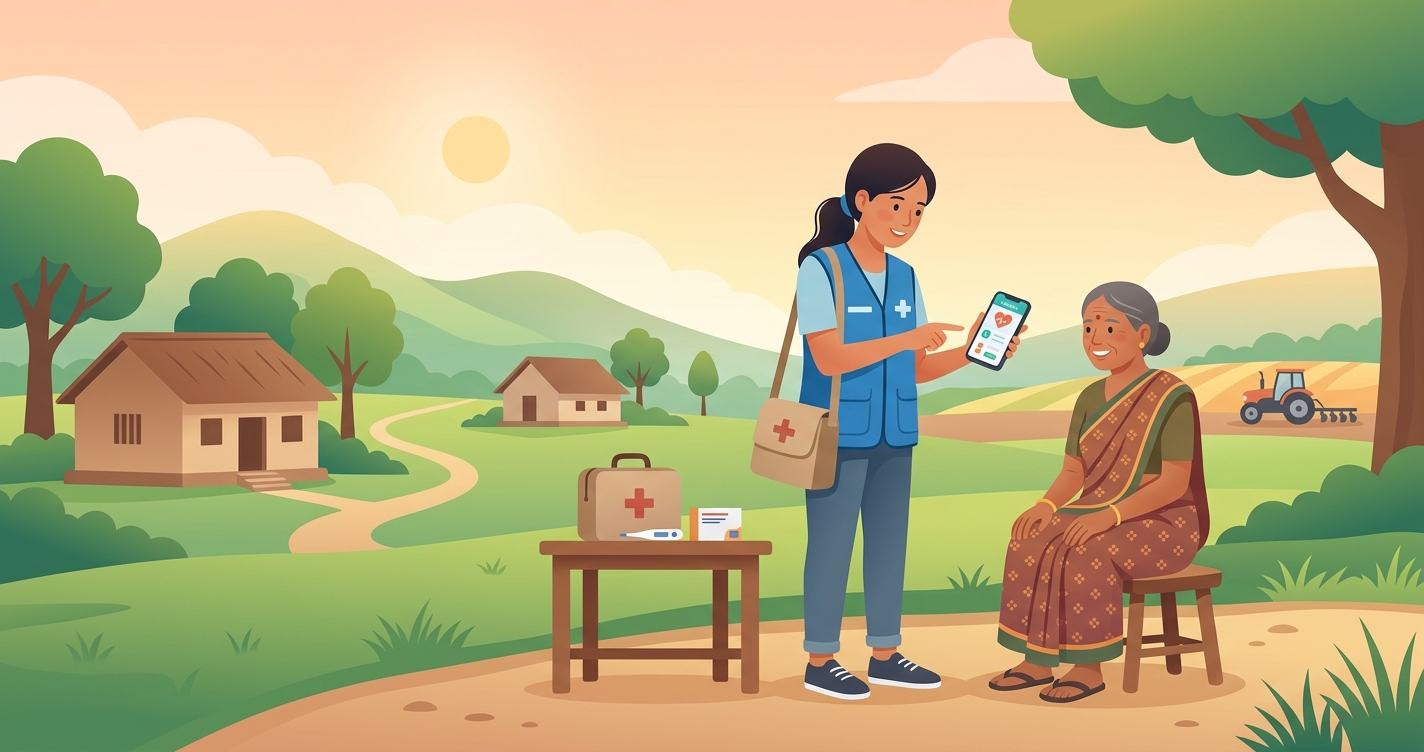
This is the clearest use case. A community health worker with a phone can handle enrollment, symptom prompts, referral checklists, decision support, and follow-up scheduling during a household visit. Braun and colleagues found that these were among the most common uses of mobile tools more than a decade ago. The basic appeal has not changed: fewer separate tools to carry, fewer paper handoffs, and a more consistent screening protocol.
Disease surveillance and outbreak monitoring
A smartphone can also do work that portable clinics struggle to do at scale: real-time distributed reporting. A rural India study covered by The BMJ found that a mobile phone-based syndromic surveillance system collected data from 20,424 patients over six months in Madhya Pradesh. Researchers reported that even data collectors with little prior smartphone experience could be trained quickly, and the system supported offline entry when networks were weak. That is exactly the sort of job a phone is good at—capturing lightweight field intelligence across distance.
Follow-up between outreach visits
Portable clinics are episodic by design. They arrive, assess, treat what they can, then move on. Phones help fill the gaps between visits. They can store contact history, flag missed referrals, support medication reminders, and keep a record of whether a suspected high-risk case ever reached a facility. For maternal health, TB, HIV, and NCD screening programs, that continuity is often the difference between a one-time event and an actual care pathway.
Low-equipment physiological screening
This is where the conversation gets more ambitious. Some programs and vendors are exploring camera-based or microphone-based signal capture through smartphones for first-pass measurement. That still does not turn a handset into a rural clinic. What it does is create another layer of screening before scarce devices or clinicians are deployed.
If you want the nearby version of this idea, our analysis of how aid workers screen patients without a single piece of equipment and how digital health reduces facility-level burden in LMICs goes deeper on field workflows.
Current research and evidence
The evidence does not really support the claim that smartphones replace portable clinics outright. It supports something narrower and more useful.
First, WHO's 2019 digital health guidance reviewed mobile decision support, telemedicine, reminders, stock reporting, and provider communication. The organization was explicit that digital tools should strengthen health systems rather than pretend to be health systems. That still feels like the cleanest frame for this question.
Second, Braun and colleagues' 2013 review showed that community health workers were already using phones across maternal and child health, HIV, and reproductive health contexts. Their review found evidence of improved efficiency, support for monitoring, and broader service reach. What stands out is how operational the benefits were. Better communication. Better data capture. Better workflow consistency. Not magic.
Third, Blondino and colleagues' 2024 survey gave newer cross-country evidence that workers are broadly receptive to digital tools. Training mattered a lot: digital-tools training was associated with higher device use and stronger belief that digital health increased community impact. Cost remained a barrier, with lower odds of work-related digital use among CHWs who cited mobile service or device cost. That finding matters because a smartphone-only strategy is only realistic if the financing model is realistic too.
Fourth, the rural India surveillance work is a reminder that field value is often about coverage, not sophistication. Collecting 20,424 patient records over six months with offline-capable phones is not the same thing as running a clinic. But it is exactly the kind of reach problem that portable clinics alone cannot solve.
A 2024 narrative review on mobile health applications for disease screening and treatment support in low- and middle-income countries adds another layer. The review found that mHealth tools are being used across infectious disease screening, non-infectious disease screening, surveillance, and treatment support, while barriers still include training gaps, privacy concerns, and weak interoperability. In other words: phones travel well, but governance still matters.
Here is the practical read on the literature:
- Smartphones can absorb a meaningful share of intake, triage, and follow-up work.
- Portable clinics still matter for exams, medications, procedures, and confirmatory tests.
- The best gains show up when phones reduce wasted clinic visits and improve referral targeting.
- Training, connectivity, and program design usually matter more than flashy technical claims.
The future of smartphone-led rural screening
I do not think the future looks like a smartphone replacing a portable clinic one-for-one. That framing is too dramatic, and honestly a little misleading.
The future looks more like rural health systems becoming layered.
A phone handles first contact. A community worker screens and records the case. A supervisor sees patterns earlier. A portable clinic is routed where unresolved need is highest. A referral facility receives fewer low-priority visits and more appropriately escalated ones. That is less cinematic than “the phone becomes the clinic,” but it is much closer to how adoption actually happens.
For global health researchers, USAID and PEPFAR implementers, and mobile health platforms, that is the strategic shift worth paying attention to. The most valuable phone workflow may be the one that helps a program deploy people, diagnostics, and transport more selectively.
Circadify is building for this broader direction: smartphone-based vital-signs and screening workflows aimed at deployment-minded teams that want less hardware friction in the field. For more on the implementation side, see Circadify’s global health case studies and research coverage.
Frequently Asked Questions
Can a smartphone fully replace a portable clinic in rural areas?
No, not in the literal sense. A smartphone can replace parts of the workflow—registration, symptom intake, triage, follow-up, and some forms of low-equipment screening—but it cannot provide treatment, physical exams, or confirmatory diagnostics on its own.
Where does a smartphone help the most in rural healthcare?
Usually at the front end and between visits. Phones are strong for first-pass screening, distributed data capture, referral tracking, and ongoing follow-up when a clinic cannot be physically present every day.
Why do some programs still prefer portable clinics?
Because portable clinics can do things a phone cannot: administer medications, run device-based checks, handle higher-acuity cases, and offer direct in-person care during outreach.
What is the best model for low-resource settings?
The literature points toward a hybrid model. Smartphones extend reach and standardize screening, while portable clinics and facilities provide confirmatory care and treatment when escalation is needed.
For related reading, see how smartphone screening integrates with DHIS2, mobile health in low-resource settings, and community health workers collecting vital signs in the field.