Building a National CHW Digital Toolkit: What to Include
A research-based analysis of what a national CHW digital toolkit should include, from supervision and offline workflows to interoperability and frontline training.
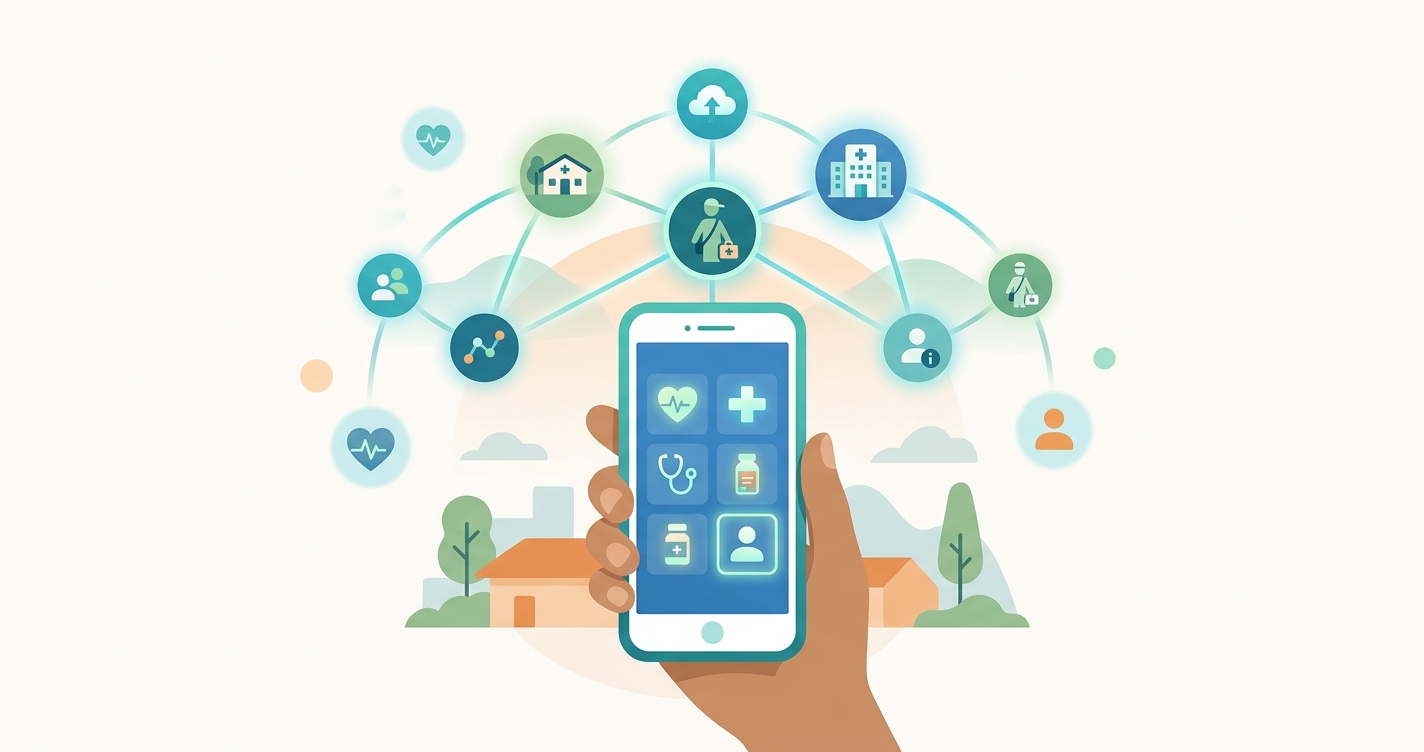
A national CHW digital toolkit is no longer just a procurement question. For ministries of health, implementing partners, and digital-health teams working across low-resource settings, it has become an operating-model decision. The real challenge is not choosing an app. It is deciding what a community health worker toolkit must contain if it needs to work across districts, survive weak connectivity, support supervision, and produce data that national programs can actually use.
"Training in digital tools significantly increased both digital device usage and belief in digital impact among CHWs." — Courtney T. Blondino, Alex Knoepflmacher, Ingrid Johnson, Cameron Fox, and Lorna Friedman, multi-country CHW survey published in BMJ Global Health (2024)
National CHW digital toolkit guide: what belongs in the core stack
The strongest national CHW digital toolkit designs tend to look less like a single product and more like a layered public-health system. The World Health Organization's 2018 guideline on optimizing community health worker programmes focused on the familiar pillars first: selection, training, supervision, data use, logistics, and long-term program support. The digital layer has to strengthen those pillars, not replace them.
That is why the WHO, UNICEF, and CHW AIM update to the Program Functionality Matrix still matters. It does not treat digital tools as magic. It treats them as part of a broader program architecture with around 15 core functionality areas that determine whether a community-health program can work at scale.
A practical national toolkit usually needs six components.
- A frontline application for screening, counseling, referrals, and follow-up
- Offline-first data capture with reliable sync rules
- Decision support tied to national protocols
- Supervisor dashboards and escalation workflows
- Interoperability with district and national systems such as DHIS2, EMRs, and FHIR-enabled services
- Training, device management, and governance tools that keep the system usable after launch
If one of those pieces is missing, the burden usually shifts back to the worker. CHWs end up writing data twice, supervisors lose visibility, or ministries inherit a pilot that cannot scale past a few districts.
Comparison of national CHW toolkit components
| Toolkit component | What it does | Why it matters nationally | Failure mode if missing |
|---|---|---|---|
| Frontline workflow app | Guides registration, triage, screening, counseling, referral, and follow-up | Standardizes service delivery across regions | Workers revert to paper or local workarounds |
| Offline-first sync | Stores records on-device and syncs when connectivity returns | Rural and conflict-affected areas stay in scope | Coverage gaps appear outside connected facilities |
| Decision support | Embeds protocols for maternal health, NCDs, TB, HIV, immunization, or child health | Reduces variation in frontline decisions | Quality depends too heavily on memory and refresher training |
| Supervisor layer | Flags missed visits, high-risk patients, stock issues, and training needs | Makes supervision continuous instead of episodic | Problems surface too late for district teams to respond |
| Interoperability layer | Sends structured data to DHIS2, EMRs, registries, or analytics tools | Prevents duplicate reporting and pilot fragmentation | National reporting stays manual and fragmented |
| Governance and training tools | Manages users, devices, updates, content, and permissions | Keeps the system stable after donor-funded rollout | Programs stall after the first deployment wave |
The offline-first piece is especially important. A national CHW digital toolkit guide that assumes consistent connectivity is usually written for the wrong environment. In medhealthscan.com's niche, the question is often not whether digital tools work in low-resource settings. It is whether they still work when a CHW is far from a facility, charging opportunities are inconsistent, and connectivity may disappear for hours or days.
Industry applications for national CHW programs
Maternal and newborn health
Maternal and newborn workflows usually expose whether a toolkit is serious. Programs need household registration, danger-sign screening, visit scheduling, referral tracking, and postpartum follow-up. If those functions are split across paper tools, messaging apps, and spreadsheets, district teams lose continuity fast.
UNICEF's recent work in Rwanda is a good example of the shift toward a more coherent national stack. In 2024, UNICEF reported that Rwanda's community electronic medical records effort was moving CHWs away from piles of paper registers and toward smartphone-based data capture tied to maternal, newborn, and child health workflows. The rollout target was national expansion to all 30 districts by the end of 2026, reaching 58,567 CHWs. That kind of scale changes the definition of a toolkit. It is no longer a pilot app. It becomes national health infrastructure.
TB, HIV, and community case finding
TB and HIV programs tend to need repeat screening, referral closure, treatment follow-up, and strong confidentiality controls. Here, the toolkit has to do more than collect data. It must support longitudinal case management, supervisor review, and secure handling of sensitive records.
A weak toolkit often handles first contact well but breaks down at follow-up. The result is familiar: lots of screening events, much less visibility into whether people reached confirmatory testing, started treatment, or dropped out somewhere between community outreach and facility care.
NCD screening and chronic care
For hypertension, diabetes risk, and other chronic conditions, CHWs need simple workflows that can be repeated at scale. That means structured assessments, risk flags, patient reminders, and a way to connect data with district systems. It also means tools that do not add too much device complexity. National toolkits that rely on too many peripherals or fragile accessories often hit cost and maintenance limits before they hit national coverage goals.
This is where zero-equipment or smartphone-based screening can fit into a broader toolkit. It is not the whole stack, but it can reduce hardware burden for frontline teams and make basic screening more deployable in field settings.
Current research and evidence
The strongest evidence says the digital layer works best when it fits the CHW program, not when it tries to sit above it.
In the 2024 multi-country survey published in BMJ Global Health, Courtney T. Blondino and colleagues surveyed 1,141 community health workers across 28 countries. They found that 80.2% were already using digital devices or tools in their work, mostly smartphones. They also found a pattern that national planners should pay attention to: training in digital tools was strongly associated with both higher usage and stronger belief that the tools improved community impact. That is a reminder that a toolkit is not just software plus phones. It is software, devices, training time, and support capacity bundled together.
WHO's 2019 guideline on digital interventions for health system strengthening reached a similar conclusion from a different angle. Digital tools can support client registration, decision support, telemedicine, and data exchange, but implementation depends on electricity, network access, usability, and sustained support. In plain terms, a ministry cannot buy its way into success with a platform license alone.
Sarah M. Rodrigues, Anil Kanduri, Adeline Nyamathi, Nikil Dutt, Pramod Khargonekar, and Amir M. Rahmani argued in JMIR Formative Research (2022) for a digital health-enabled community-centered care model that gives CHWs a stronger digital backbone for continuous support and more personalized interventions. Their work is partly forward-looking, but the basic point holds up: the future toolkit is likely to combine frontline data capture, supervision, and automated decision support in a much tighter loop than most current deployments manage.
Meanwhile, the WHO-UNICEF-CHW AIM Program Functionality Matrix remains useful because it keeps program leaders from over-indexing on the app. A national toolkit has to be judged against supervision, financing, referral design, supply support, monitoring, and accountability. Otherwise, countries risk scaling software without scaling the program conditions that make the software useful.
A few evidence-backed design conclusions show up again and again:
- Training is not optional. It changes usage levels.
- Supervision has to be built into the digital workflow, not handled as an afterthought.
- Interoperability matters more at national scale than feature count.
- Offline reliability is a core requirement, not a premium feature.
- The best toolkit is usually modular enough to support multiple programs without forcing every region into a separate app.
The future of national CHW digital toolkit design
The next generation of toolkit design will probably move in three directions at once.
First, countries will expect more integrated frontline workflows. Instead of one tool for maternal health, another for immunization, and a third for referral follow-up, national teams will push for shared identity, shared records, and configurable workflows on top of one platform backbone.
Second, supervision will become more real time. The Rwanda cEMR example points in that direction already. Supervisors can see information sooner, identify missed follow-up earlier, and coach staff before problems harden into quarterly reporting gaps.
Third, device-light screening will become easier to add. For some programs, that may mean digital questionnaires and scheduling. For others, it may mean smartphone-based vitals or camera-enabled screening layered into existing outreach work. The strategic value is not novelty. It is reducing the amount of extra hardware a national program has to buy, distribute, replace, and maintain.
I keep coming back to one simple test. If a national CHW digital toolkit makes life easier for a donor presentation but harder for the worker holding the phone, it is not ready. The winning designs are the ones that make a CHW faster, make a supervisor less blind, and make national data less fragmented.
Frequently Asked Questions
What is a national CHW digital toolkit?
It is the combination of software, devices, workflows, supervision tools, interoperability standards, and training systems used to support community health workers across a national program. In practice, it should cover both frontline service delivery and the systems around it.
What should a CHW toolkit include first?
The core usually starts with a frontline app, offline data capture, protocol-based decision support, supervisor dashboards, and interoperability with national reporting systems. Training and governance tools should be treated as part of the core, not as optional extras.
Why is offline-first design so important for CHW programs?
Because many CHWs work in areas where connectivity is unreliable. If the toolkit depends on a stable connection, coverage shrinks to the easiest places to serve and national equity goals suffer.
How do countries avoid fragmented CHW digital pilots?
They usually do it by using common standards, shared registries, and national governance rules for data exchange, user management, and reporting. A toolkit that cannot connect to district and national systems often becomes another isolated pilot.
For related reading, see our analysis of mobile health in low-resource settings, smartphone screening integration with DHIS2, and how digital health reduces facility-level burden in LMICs. For broader global-health research and deployment context, visit Circadify's global health hub.