
How to Validate Smartphone Vital Signs Against Clinical-Grade Devices
A research-based analysis of how teams validate smartphone vital signs against clinical-grade devices in low-resource and field deployment settings.
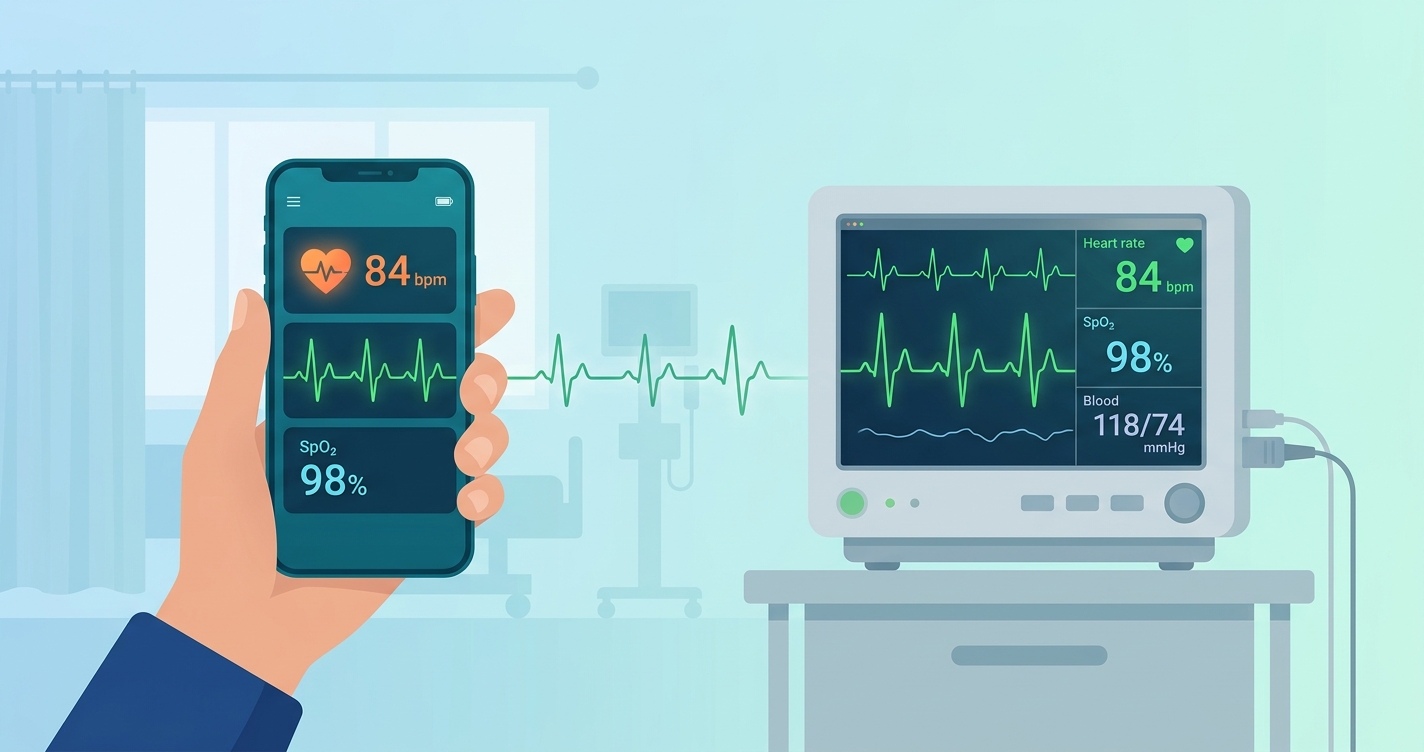
Validating smartphone vital signs against clinical-grade devices sounds straightforward until a team tries to do it in the real world. In low-resource settings, the question is rarely whether a smartphone can produce a number. The harder question is whether that number holds up against a trusted reference device across different light conditions, different users, different skin tones, and the kind of movement that shows up in actual field work. That is why validation has become one of the most important design steps in mobile health low-resource settings.
"Consumer-grade contactless monitors were accurate in measuring heart rate when compared to medical devices, but evidence for blood pressure and respiratory rate remained limited." — Senura M. Munasinghe and colleagues, systematic review and meta-analysis in JMIR Biomedical Engineering (2022)
Validate smartphone vital signs against clinical-grade devices: what teams are actually proving
When teams validate smartphone vital signs against clinical-grade devices, they are usually trying to answer four separate questions at once.
First, can the smartphone measurement track the reference device closely enough to be useful? Second, does that agreement hold up across different populations and care settings? Third, what conditions break performance? And fourth, what is the intended use: screening, triage, longitudinal monitoring, or diagnosis?
That last point matters more than people admit. A validation plan for community screening in rural districts should not look identical to a validation plan for inpatient monitoring. Clinical reference devices set the benchmark, but the workflow, environment, and decision threshold determine what "good enough" means.
A sensible validation package usually includes:
- A clearly defined reference device for each parameter
- Simultaneous or near-simultaneous measurements
- A protocol for lighting, posture, distance, and rest period
- Agreement statistics such as mean absolute error, bias, limits of agreement, and correlation
- Subgroup analysis for age, skin tone, disease state, and field conditions
- A decision about where the smartphone output sits in the care pathway
Comparison table: smartphone validation framework vs field reality
| Validation element | Why it matters | Typical clinical-grade reference | What can go wrong in the field |
|---|---|---|---|
| Heart rate agreement | Shows whether signal extraction is stable | ECG monitor or hospital pulse oximeter | Motion, poor framing, low light |
| Respiratory rate agreement | Tests whether video or motion-derived breathing tracks observation | Capnography, bedside monitor, or trained manual count | Clothing movement, talking, coughing |
| Blood pressure comparison | Assesses whether estimation is close enough for intended use | Validated oscillometric BP device following ISO-style methods | Position changes, cuff timing mismatch, calibration drift in the reference device |
| Oxygen saturation comparison | Checks whether optical estimates stay near pulse oximeter values | Clinical pulse oximeter | Low perfusion, darker environments, finger-device variability |
| Usability under deployment conditions | Determines whether results survive outside lab settings | Operational study with trained staff and supervisors | CHW turnover, phone variation, inconsistent protocols |
The best teams do not stop at a strong lab result. They ask whether the method still works after a long day in the field, on lower-cost Android phones, and with users who are not clinical research coordinators.
Industry applications in low-resource settings
Community health screening
For community health workers, validation is usually about triage confidence. If a smartphone workflow is being used to flag who needs referral, the crucial question is whether the tool behaves consistently enough against a trusted device to support screening decisions. In these settings, a perfect one-to-one match is less important than predictable performance and well-understood thresholds.
That is why heart rate has moved ahead first. Munasinghe and colleagues found that most contactless consumer-grade studies focused on heart rate, not the full vital-sign stack. The evidence base is simply deeper there.
Facility-linked mHealth programs
Programs tied to district hospitals or referral facilities usually need a tighter protocol. Here, smartphone measurements may be compared with bedside monitors or validated spot-check devices before the data is fed into DHIS2, research dashboards, or program evaluations. Validation becomes partly technical and partly operational: can nurses, CHWs, and supervisors repeat the protocol the same way every time?
Research deployments and implementation studies
Academic and donor-funded pilots often care about subgroup performance. This is where validation becomes more serious. Researchers want to know whether agreement changes with cardiovascular disease, respiratory illness, ambient lighting, or differences in participant phenotype.
A 2024 study in Frontiers in Digital Health by Peter H. Charlton and colleagues looked at rPPG pulse-rate monitoring in 47 adults with cardiovascular disease. Compared with ECG, the software's mean absolute error was 1.061 beats per minute, with a Pearson correlation of 0.962. That is encouraging, especially because the cohort was not limited to healthy volunteers. Still, the same paper argued for more work in broader populations and more demanding scenarios.
Current research and evidence
The literature is starting to separate into two camps: parameters with a fairly mature validation story and parameters that still need more evidence.
Heart rate belongs in the first camp. In the 2022 systematic review and meta-analysis by Senura M. Munasinghe, Damayanthi N. Seneviratne, and colleagues, 26 studies were reviewed and 22 of them measured heart rate. The authors found that consumer-grade contactless monitors were accurate for heart rate when compared with medical devices, while evidence for blood pressure and respiratory rate was thinner and often based on small laboratory studies.
That conclusion lines up with the prospective smartphone study from Google Health. In a 2024 npj Digital Medicine paper, R. Pratap, Y. Kwon, and co-authors validated smartphone-based heart-rate and respiratory-rate algorithms. The respiratory-rate model achieved a mean absolute error of 0.78 breaths per minute, well below the prespecified threshold of 3 breaths per minute. What I like about that study is that it treated usability as part of validation, not as an afterthought.
For pulse rate in cardiovascular disease populations, Charlton and colleagues add another useful point: validation should not rely only on healthy users sitting perfectly still. Their study suggests contactless pulse-rate monitoring can remain reasonably accurate in a clinically relevant cohort, but it also makes the broader lesson obvious. You do not really know how robust a smartphone measurement is until you test it in the population you plan to serve.
There is also a standards question hiding underneath all of this. The World Health Organization's 2023 target product profile for pulse oximeters and its guidance on blood pressure measuring devices make a practical point: reference devices are not interchangeable just because they are common. Validation depends on using the right benchmark, with known performance requirements, appropriate operating conditions, and a protocol that fits the setting. In other words, a smartphone tool cannot be "validated" against a weak reference and call it a day.
A few evidence-backed principles show up repeatedly:
- Validate each vital sign separately. Strong pulse-rate results do not automatically transfer to blood pressure or SpO2.
- Match the protocol to the intended deployment setting, not just the lab.
- Use simultaneous or tightly synchronized measurements whenever possible.
- Record failure cases, not just successful readings.
- Analyze subgroups instead of reporting one average result for everyone.
- Treat the reference workflow as part of the study design, because even the benchmark device can be used badly.
Where validation often breaks down
The biggest mistake is treating validation as a one-time technical milestone. In practice, it is a chain of decisions.
A team may choose a strong reference device but compare readings minutes apart. Or it may collect beautifully synchronized data indoors and then deploy the workflow outdoors without checking glare, motion, and heat. Sometimes the problem is more mundane: different phone models produce different camera quality, exposure behavior, and frame stability.
I keep coming back to this because global health pilots are especially vulnerable to "clean study, messy deployment" syndrome. A protocol that works in a university lab may fall apart during outreach days, campaign queues, or household visits.
Another common problem is overclaiming the endpoint. Heart-rate validation is not proof that a full contactless screening stack is clinically interchangeable with standard instruments. The literature is not there yet. The more honest and more useful framing is parameter by parameter, use case by use case.
The future of validation in smartphone vital signs
The next phase will probably look less like isolated feasibility studies and more like layered validation.
One layer will test signal quality and agreement against ECG, pulse oximeters, and validated blood-pressure devices. Another will test repeatability across phone models and lighting conditions. A third will look at workflow fit: whether community health workers can capture usable measurements consistently after short training.
That shift matters for medhealthscan.com's audience. Global health implementers do not just need a technically interesting model. They need evidence that survives procurement variation, supervision gaps, intermittent power, and the realities of frontline care.
I also expect regulators, ministries, and donors to ask harder questions about dataset diversity. If validation cohorts are too narrow, deployment risk rises fast. A stronger evidence base will need multi-site studies, more transparent reporting of failure rates, and clearer separation between screening claims and diagnostic claims.
Frequently Asked Questions
What does it mean to validate smartphone vital signs against clinical-grade devices?
It means comparing smartphone-derived measurements with trusted reference devices such as ECG monitors, validated blood pressure monitors, or clinical pulse oximeters using a predefined protocol and agreement statistics.
Which smartphone vital sign is easiest to validate today?
Heart rate has the strongest evidence base so far. Systematic reviews show far more heart-rate studies than blood pressure, respiratory rate, or oxygen saturation studies.
Why are field studies different from lab validation studies?
Field studies include motion, variable lighting, lower-cost phones, and less controlled user behavior. Those factors can change performance even when a lab study looks strong.
Can a smartphone replace clinical-grade devices after validation?
That depends on the intended use. Many programs position smartphone measurements as screening or triage tools rather than direct substitutes for diagnostic instruments.
For related reading, see our analyses of mobile health in low-resource settings and how community health workers collect vital signs in the field. If you are tracking how smartphone-based screening is being evaluated in global health deployments, the broader research context is covered on Circadify's global health blog.